
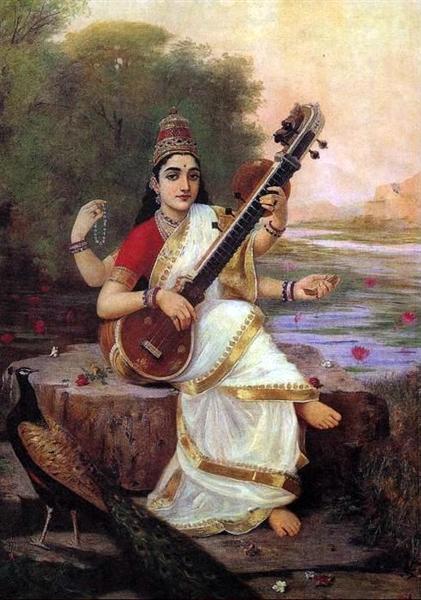
Painting of Goddess Saraswati
Artwork Details
Name of Art
Goddess Saraswati
Artist
Raja Ravi Varma
Art Type
Painting
Year
Verify specific artwork
Location
Verify specific artwork
Raja Ravi Varma’s painting of Goddess Saraswati brings the Hindu goddess of knowledge, music, and learning into a world
of remarkable realism. Seated gracefully beside a lotus pond, Saraswati holds a veena, a manuscript, and a rosary, each carrying its own association with wisdom, creativity, and spiritual understanding. Her white clothing, composed expression, and elegant posture create an image that feels serene without being distant. Rather than presenting the goddess as an abstract divine presence, Ravi Varma gives her a human form that feels familiar, almost as if she could step out of the painting and into the world around us.
What makes Ravi Varma’s interpretation particularly interesting is his ability to combine European academic painting techniques with Indian religious subjects. Having studied European approaches to anatomy, perspective, shading, and oil painting, he brought a sense of physical realism to figures that had traditionally been represented through different regional and religious artistic conventions. In Saraswati, this realism is visible in the folds of her clothing, the softness of her features, and the way light falls across her figure. The goddess remains unmistakably divine, yet the painting allows viewers to encounter her through the visual language of portraiture.
The objects surrounding Saraswati are not merely decorative. The veena connects her to music and the arts, while the manuscript represents learning and knowledge. The rosary evokes spiritual discipline and contemplation. Together, these elements make the composition a visual expression of the many forms that wisdom can take. The lotus and the natural setting further reinforce the association between beauty, purity, and spiritual awareness. Every object contributes to the story, allowing the painting to communicate its meaning without relying on elaborate narrative.
Ravi Varma’s influence extended far beyond the walls of galleries and royal collections. Through the establishment of his lithographic press in the late nineteenth century, his images of Hindu deities could be reproduced and distributed on a much wider scale. Religious imagery that had once been encountered primarily through temples, manuscripts, or local traditions could now enter homes across India. This helped establish a recognisable visual vocabulary for many Hindu gods and goddesses, including Saraswati, and transformed the relationship between devotional imagery and popular culture.
The painting’s lasting appeal lies in this balance between the sacred and the familiar. Saraswati is presented as a goddess worthy of reverence, but also as a figure whose beauty, gestures, and surroundings can be understood by anyone looking at the canvas. Ravi Varma did not simply paint a religious subject; he helped shape how that subject could be seen, remembered, and reproduced. His Saraswati remains an example of how art can preserve cultural beliefs while changing the way an entire generation experiences them.