
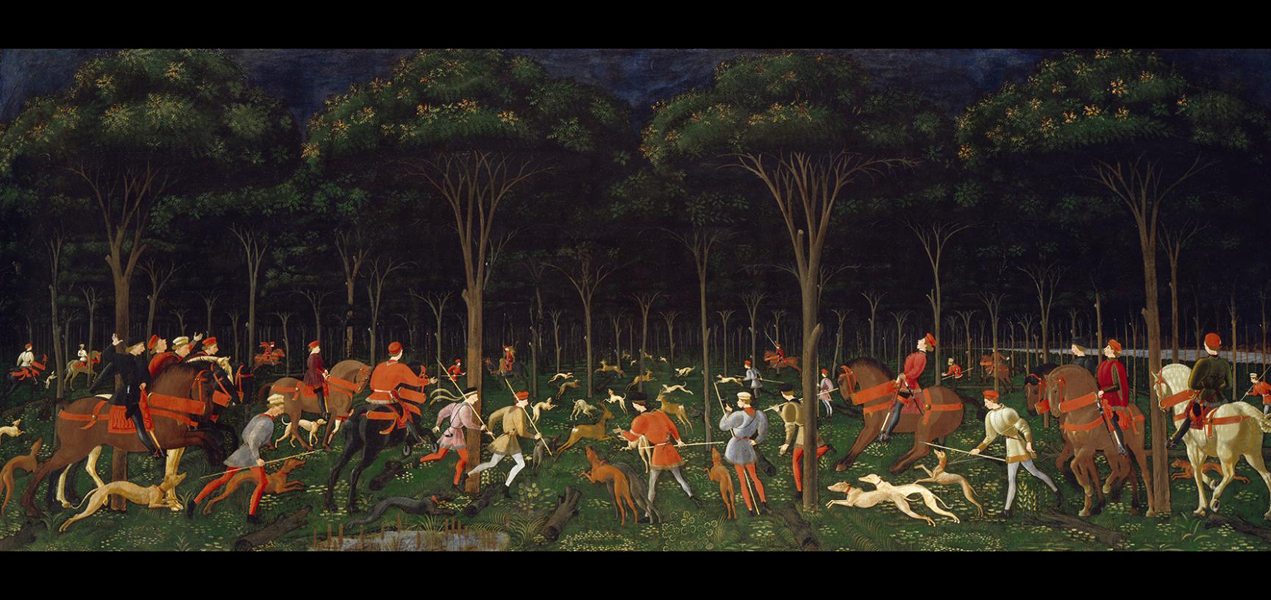
The Hunt in the Forest
Artwork Details
Name of Art
The Hunt in the Forest
Artist
Paolo Uccello
Art Type
Panel Painting
Year
c. 1465–1470
Location
Ashmolean Museum, Oxford, UK
Paolo Uccello’s The Hunt in the Forest, painted around 1465–1470, depicts a nocturnal hunting scene filled with huntsmen, horses, hounds, and deer disappearing into a dense forest. The long, horizontal composition draws the viewer into a world of movement, with figures arranged across the foreground and gradually diminishing into the darkness. Spears point towards the distance, branches and logs lie scattered across the ground, and patches of water reflect the carefully constructed arrangement of the scene. What initially appears to be a lively account of an aristocratic pastime reveals itself to be something far more deliberate: a painting designed around the illusion of depth.
Uccello was celebrated for his fascination with perspective, animals, and landscape. Working during the Italian Renaissance, a period when artists were increasingly interested in representing three-dimensional space on flat surfaces, he approached painting with an almost mathematical curiosity. In The Hunt in the Forest, he organised the scene around a central vanishing point, using the diminishing size of the figures and the arrangement of objects to guide the viewer’s eye into the distance. The spears carried by the huntsmen, the cut branches, the logs, and the water all contribute to the illusion. Rather than simply filling the canvas with activity, Uccello gives every element a role in constructing the space.
The painting’s use of darkness is equally important. The forest creates a dramatic backdrop against which the brightly coloured figures become more prominent. Originally, gold details highlighted the foliage, catching the light and adding another layer of richness to the scene. Viewed by candlelight, these gold accents would have made the painting appear even more luminous and theatrical. The darkness is not merely a representation of night; it also helps organise the composition, allowing the viewer to distinguish the figures while following their movement deeper into the forest.
Despite the apparent realism of its animals and landscape, the scene was never intended to be a straightforward record of an actual hunt. Hunting was an aristocratic pastime associated with wealth, status, and elaborate social rituals. The crescent moon, a symbol associated with Diana, the classical goddess of the hunt, appears on the horses’ trappings. This detail adds a symbolic dimension to the scene, while the idea of a hunt taking place at night gives the painting an almost dreamlike quality. Its carefully arranged figures and unusually theatrical setting suggest an imagined world shaped as much by artistic design as by observation.
The painting was also created for a very different viewing experience from the one we have today. Its elongated shape identifies it as a spalliera painting, designed to be viewed at approximately shoulder height, perhaps as part of the decoration of a chest or the panelling of a room. The original patron remains unknown, but the Ashmolean Museum suggests that it was intended for a luxurious domestic interior, possibly in Urbino or Florence. In this setting, the painting would have been part of an environment of carefully chosen objects and decorative details, rather than an isolated work on a gallery wall.
What makes The Hunt in the Forest remarkable is the way Uccello brings together mathematical precision and visual imagination. The perspective is carefully controlled, yet the scene remains energetic and slightly mysterious. The animals and huntsmen seem to move through a space that is both believable and strangely theatrical. Every spear, tree, and figure contributes to the illusion, but the painting never feels like a mere demonstration of technique. Instead, its geometry becomes the structure that holds the entire scene together.
Today, the painting remains one of the best-known works in the Ashmolean Museum’s collection and an extraordinary example of the Renaissance fascination with perspective. Uccello transformed a familiar aristocratic pastime into an elaborate visual construction, demonstrating how mathematics could serve the imagination rather than restrict it. The deeper we look into the forest, the more clearly we see the artist’s hand at work, quietly directing our gaze through a world that exists somewhere between observation, design, and illusion.