
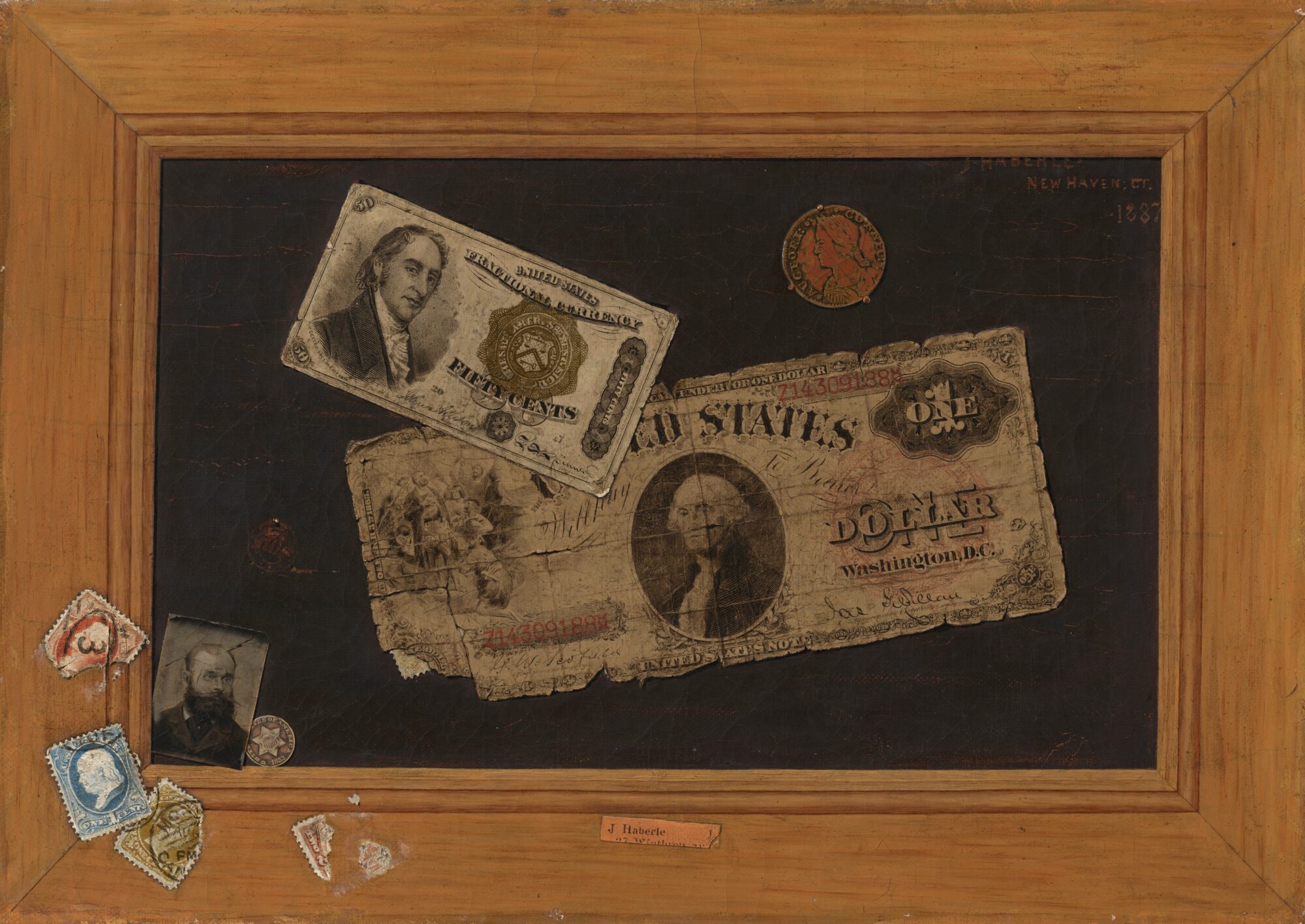
Most Dangerous Thing to Paint Was Money
Artwork Details
Name of Art
Imitation
Artist
John Haberle
Art Type
Painting
Year
1887
Location
America
Imitation (1887) by John Haberle is a trompe l’oeil painting of paper money and small flat object. Painted so precisely that viewers believed it was the real thing. Trompe l’oeil means “deceive the eye” in French. Haberle used it to make a painting that people wanted to touch to check.
What is trompe l’oeil?
Trompe l’oeil is a style of painting that makes flat objects look physically present. In late 19th-century America, a small group of painters, including William Harnett and John Haberle, specialized in it. Their favorite subjects were things that are already flat: letters, photographs, newspaper clippings and banknotes. Flat subjects are the hardest test. There is no shadow or depth to hide behind, so every crease and every printed line has to be exact.
Why painting money was a risk?
In the 1880s, painting realistic currency could draw the attention of the US Secret Service, which was responsible for fighting counterfeiting. Harnett was warned to stop painting money in the mid-1880s. Haberle painted it anyway. The title Imitation reads like a reply to critics who dismissed this kind of painting as mere copying: yes, it is an imitation, and that is the whole point.
Why it still matters
Haberle understood something marketers forget: people trust what feels physically real. A painting that invites the hand holds attention longer than one that only asks to be looked at. The same is true of a brochure, an invitation or a packaging box today. When something feels real enough to touch, people stop and engage with it.
See it
Imitation is in the collection of the National Gallery of Art, Washington (accession 1998.96.1), and its image is open access. Other money artworks in the same collection include Victor Dubreuil’s Safe Money and Roy Lichtenstein’s Ten Dollar Bill (1956).
FAQ
Who painted Imitation (1887)?
The American painter John Haberle, a specialist in trompe l’oeil still life.
Was it illegal to paint money?
Painting currency realistically raised counterfeiting concerns, and US authorities warned at least one painter, William Harnett, in the 1880s.
What does trompe l’oeil mean?
“Deceive the eye”: painting that makes flat objects look physically present.
Read About: Painting of Goddess Saraswati