
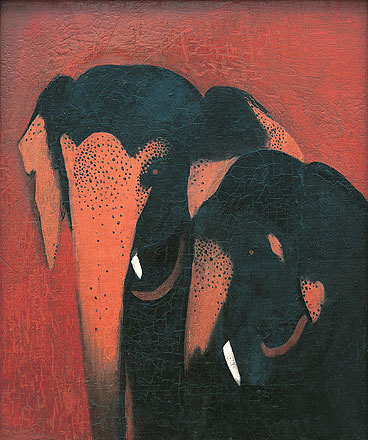
Two Elephants
Artwork Details
Name of Art
Two Elephants
Artist
Amrita Sher-Gil
Art Type
Painting
Year
1940
Location
Verify current collection
Amrita Sher-Gil’s Two Elephants, painted in 1940, belongs to a remarkable group of works created during the final years of her short but influential career. The painting reflects her growing interest in animal life, vegetation, and the relationship between figures and their surroundings. Elephants appear repeatedly in her work from this period, alongside other animals such as camels. Rather than treating them simply as decorative subjects, Sher-Gil explored their forms as part of a broader investigation into colour, shape, and the use of space on a canvas.
Sher-Gil’s artistic journey was shaped by two very different worlds. Born in 1913 to a Hungarian mother and an Indian father, she received formal art training in Paris, where she encountered European academic painting and Post-Impressionism. In the mid-1930s, she returned to India with a desire to make the country her home. Her encounters with Indian miniature painting traditions, as well as her visits to the Ajanta and Ellora caves and travels through South India, transformed the way she approached her subjects. Her palette grew more saturated, with intense reds, ochres, browns, yellows, and greens becoming increasingly prominent.
By 1940, these influences had begun to converge in a distinctive visual language. Sher-Gil increasingly combined architecture, figures, animal life, and vegetation within compositions that differed from the European academic traditions in which she had trained. Her subjects were often simplified into strong, clearly defined forms, while colour played an important role in establishing their presence. In Two Elephants, the subject offers an opportunity to consider this change in her practice: animals become central to the composition rather than incidental elements within a larger narrative. The painting belongs to a period when she was experimenting with how forms could occupy space and how colour could give an image its character.
What makes Sher-Gil’s work particularly compelling is that her artistic development was never simply a movement away from European influences towards Indian ones. She absorbed elements from both, reshaping them into something personal. Her European training gave her an understanding of anatomy, composition, and the handling of oil paint, while Indian art traditions opened up different possibilities for colour, decorative arrangements, and the relationship between figures and their environment. The result was neither a straightforward imitation of Western modernism nor a return to traditional Indian painting. It was a modern visual language grounded in her own experiences and observations.
Sher-Gil’s interest in animals also reveals the breadth of her artistic curiosity. Although she is widely remembered for her portraits and paintings of Indian women, rural communities, and everyday life, her animal studies show that her attention extended beyond human subjects. These works allowed her to explore form and movement while continuing to develop her distinctive treatment of colour and space. The elephants, camels, and other animals she painted in 1940 form part of a larger body of work that demonstrates how actively she was experimenting during this period.
Sher-Gil died in 1941 at just 28 years of age, leaving behind a body of work that would become foundational to modern Indian art. Two Elephants offers a glimpse into the direction her practice was taking at the time. It reminds us that her contribution extended beyond the subjects for which she is best known. Through her treatment of animals, landscape, colour, and composition, she continued to challenge the boundaries between artistic traditions and create a visual language that was distinctly her own.