
Muybridge’s Horse in Motion: How One Question Invented the Movies
Artwork Details
Name of Art
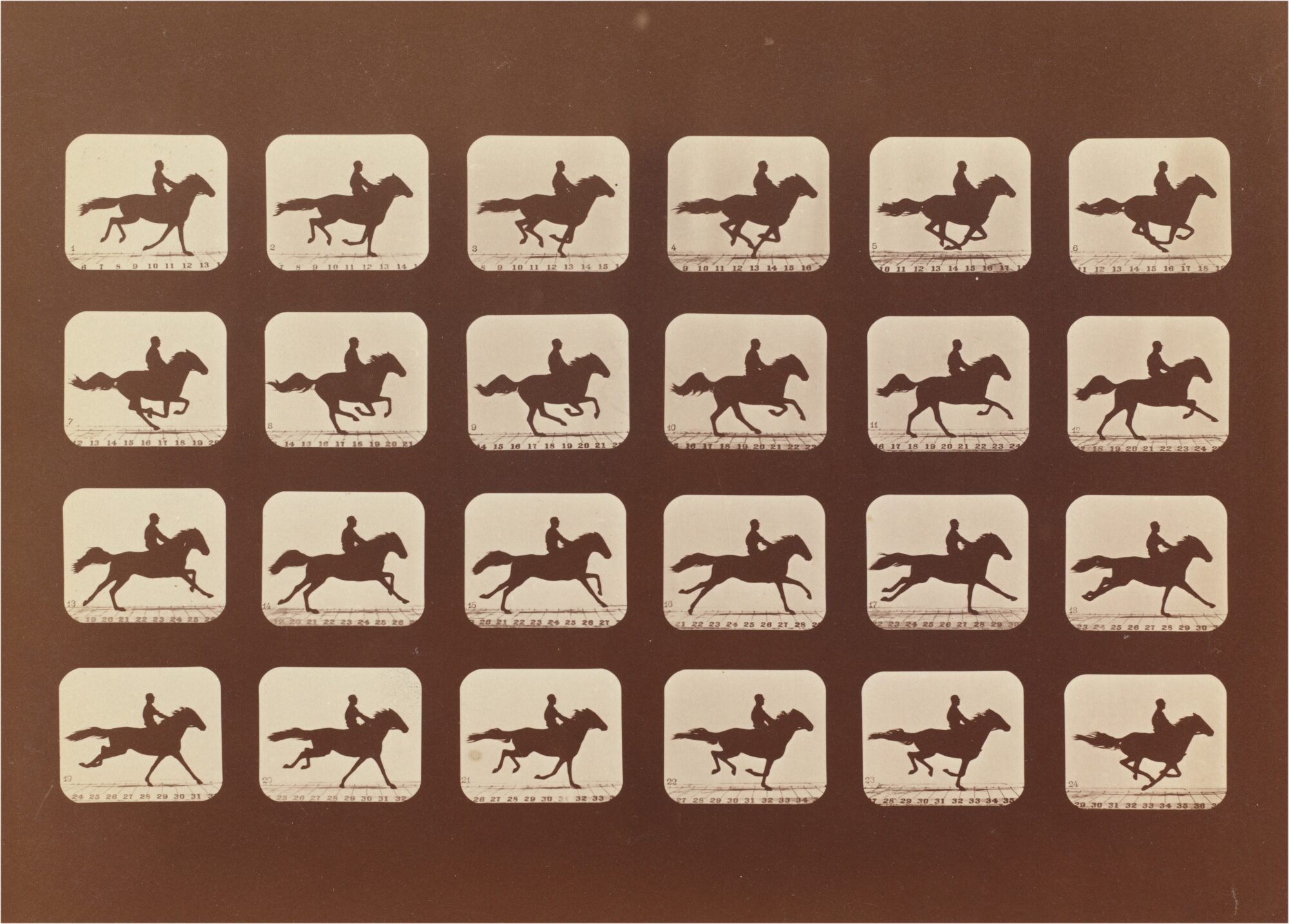
Horses. Running. Phyrne L. No. 40
Artist
Eadweard Muybridge
Medium
Albumen silver print
Year
1879
Location
America
Muybridge’s horse in motion is a set of photographs Eadweard Muybridge took in 1878, using a line of camera triggered in sequence to capture a galloping horse. The pictures proved that all four of a running horse’s hooves leave the ground at once, and the sequence became one of the foundations of motion pictures.
One question behind the horse in motion
Leland Stanford, the railway businessman and former Governor of California, wanted to know how a horse really moves at speed. The eye is too slow to see it, and painters had long guessed wrong. Stanford backed Muybridge to find out.
Twelve cameras and a tripwire
At Stanford’s farm Palo Alto, Muybridge lined up cameras along the track. As the horse ran past, it triggered each camera in turn, capturing a frame every fraction of a second. The Muybridge horse in motion photos showed a moment, mid-stride, with every hoof in the air. He later projected sequences like this with a device he called the zoopraxiscope, an early form of moving pictures.
From horse in motion to Animal Locomotion
Muybridge went on to photograph people and animals in motion for years, publishing Animal Locomotion in 1887. Horses. Running. Phryne L.No. 40 (1879) is one of his studies of horse in motion.
Why it still matters?
Muybridge’s horse in motion is a reminder that new visual technology starts with curiosity, not tools. The tools are new; the instinct is the same; a question worth answering and the patience to show it frame by frame.
See it
National Gallery of Art, Washington, Gift of Mary and Dan Solomon (2006.131.7). The NGA holds over 750 works by Muybridge.
What did Muybridge’s horse in motion prove?
That a galloping horse has all four hooves off the ground at one point in its stride.
When did Muybridge photograph the horse in motion?
In 1878, at Leland Stanford’s farm in Palo Alto, California.
How did Muybridge influence film?
His sequential photographs, and his projection of them with the zoopraxiscope, were early steps toward motion pictures.