
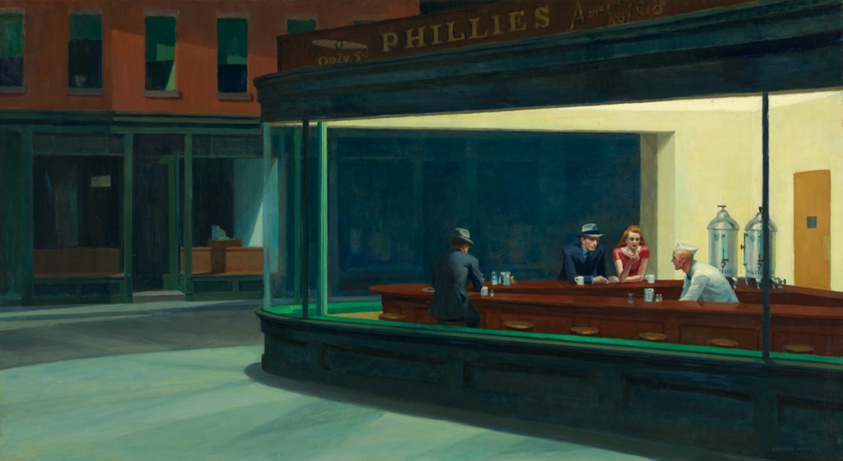
Nighthawks
Artwork Details
Name of Art
Nighthawks
Artist
Edward Hopper
Art Type
Oil Painting
Year
1942
Location
Art Institute of Chicago, USA
Edward Hopper’s Nighthawks, painted in 1942, depicts four people inside a brightly lit diner on an otherwise deserted city street. A man and a woman sit together at the counter, while another customer sits nearby with his back partly turned towards the viewer. Behind the counter, a server attends to the space around them. Outside, the streets are empty, the buildings are dark, and there is little indication of life beyond the diner. The large glass window offers an unobstructed view of the interior, making the viewer feel like a passerby who has stopped to look inside. Yet, despite being able to see almost everything, we know remarkably little about the people within it.
Hopper’s decision to simplify the scene is central to its impact. The diner occupies a sharp, wedge-shaped corner, with the counter and the sweeping glass window guiding the eye across the canvas. Its artificial light spills into the darkness, creating a striking contrast between the warmth of the interior and the emptiness outside. The colours are restrained, with greens, reds, yellows, and deep shadows carefully arranged to make the diner appear almost luminous. The figures are clearly visible, but their expressions and gestures reveal very little. They seem to occupy the same room without necessarily sharing the same experience.
One of the painting’s most intriguing details is what cannot be seen. There is no obvious entrance to the diner from the viewer’s angle. The glass seems to form an uninterrupted barrier between the people inside and the world outside. This compositional choice creates an unusual tension. We are close enough to observe the scene, yet remain completely excluded from it. The figures appear equally distant from one another, despite sitting only a short distance apart. Hopper transforms an ordinary architectural feature into an emotional boundary, making the window as important to the painting as the people themselves.
The painting was inspired by a diner near Greenwich Avenue in New York, where two streets meet. Hopper later explained that he had simplified the actual scene and enlarged the restaurant. The result is not a literal record of a particular establishment, but a carefully constructed image that feels both specific and universal. The red-haired woman was modelled by Hopper’s wife, Josephine, while the other figures remain anonymous. There are no clear clues about their relationships, their conversations, or what brought them together that night. The absence of a defined narrative allows viewers to imagine their own stories.
Hopper resisted the idea that his paintings were deliberately designed as symbols of loneliness, although he acknowledged that Nighthawks may have unconsciously expressed the isolation of a large city. That distinction matters. The painting does not tell us that the figures are lonely; it simply presents a situation in which solitude seems possible, even in the presence of others. The diner could be a refuge from the night, a place of routine, or a temporary pause in someone’s life. Its meaning shifts depending on what the viewer brings to it.
Over time, Nighthawks has become one of the most recognisable images in American art, frequently referenced in films, photography, advertising, and popular culture. Its cinematic framing, dramatic lighting, and ambiguous characters make it feel like a still from a film whose beginning and ending we have missed. More than eight decades after it was painted, the scene remains familiar because its central question has not lost its relevance: how can people be surrounded by others and still feel entirely alone?